Thursday, June 26, 2014

Nearly 50 killed in fresh CAR violence


French soldiers of the "Sangaris Operation" secure the perimeter around a site where World Cup football matches will be broadcast, in Bangui, Central African Republic. French soldiers of the “Sangaris Operation” secure the perimeter around a site where World Cup football matches will be broadcast, in Bangui, Central African Republic.


BANGUI: Nearly 50 people have been killed in three days in a fresh surge of sectarian violence in the Central African Republic, a peacekeeping officer said Wednesday.


The violence was triggered by the killing of 17 Muslims at a camp in the central Bambari region on Monday, by gunmen claiming to be from a mostly Christian militia called the anti-balaka.


“Nearly 50 people have been killed since Monday during violence in the Bambari region and nearby villages,” the officer from the African Union force MISCA told AFP. “Most of the victims were shot or stabbed to death.”


Peacekeepers say there have been a series of tit-for-tat attacks in the region following the massacre.


The officer said that the violence has been carried out both by “uncontrolled individuals and by small groups,” and that civilians were fleeing toward the cathedral, the archbishops palace, and local government buildings for safety.


“Apart from attacks aimed at civilians and the burning down of houses, there are also clashes that appear to be coordinated attacks by armed groups,” both from Christian and Muslim militias, said the officer, who spoke on condition of anonymity.


The Central African Republic has seen more than a year of unrest since the mainly Muslim Seleka rebel group seized power in a coup, unfurling a vicious cycle of violence with largely Christian militias.


Invalid item ID specified
Nearly 50 killed in fresh CAR violence

Wednesday, June 25, 2014

France fire blanks, Ecuador eliminated


France's Karim Benzema shoots as Ecuador's Frickson Erazo attempts a block. France’s Karim Benzema shoots as Ecuador’s Frickson Erazo attempts a block.


RIO DE JANEIRO: Ten-man Ecuador bravely held France to a 0-0 draw at Rio’s Maracana stadium on Wednesday but the European favorites still topped Group E to gain a second round tie against Nigeria.


Through luck, determination, bad finishing and brilliant goalkeeping by Alexander Dominguez, Ecuador resisted even after captain and Manchester United winger Antonio Valencia was ordered off early in the second half for a studs up challenge on Lucas Digne.


The result was disappointing for French coach Didier Deschamps but was enough to take top place with seven points and the easier of the possible second round ties next Monday. Switzerland’s 3-0 win over Honduras in the group’s other game gave them second place and a tough match against Argentina on Tuesday. Ecuador become the first South American side to be knocked out of this World Cup.


Deschamps made six changes for this game and will certainly bring back several of the missing players to take on Nigeria.


Karim Benzema, scorer of three goals in wins over Honduras and Switzerland, kept his place in the side, but France missed the creativity of Mathieu Valbuena and Yohan Cabaye, the latter absent due to suspension and replaced by Southampton’s Morgan Schneiderlin.


Les Bleus controlled much of the first half, but only sporadically troubled Alexander Dominguez in the Ecuador goal.


The Ecuadorean ‘keeper held a crisply-struck volley from Moussa Sissoko with 15 minutes played and did well to palm the ball over the bar when Paul Pogba got his head to an Antoine Griezmann free-kick.

Ecuador began to threaten as the half wore on, almost breaking through when Enner Valencia rose above Digne to connect with Michael Arroyo’s left-wing cross only for Hugo Lloris to intervene.


Many of the Maracana crowd greeted the half-time whistle with jeers, but the match came to life within moments of the restart.


A flowing French move saw Benzema and Paul Pogba combine to set up Bacary Sagna on the right, and his low cross to the near post was met by Griezmann. However, a combination of Dominguez and the woodwork denied the Real Sociedad man the opening goal.


Reinaldo Rueda’s side were then dealt a major blow when Valencia was sent off with the second period just four minutes old.


The Ecuador captain lost control of the ball on the right flank and scraped his studs along Digne’s left leg, leaving his opponent in apparent agony on the turf.


Valencia received a straight red card from the Ivorian referee, but Digne was able to carry on as France sought to make the most of their extra man.


Benzema set up Blaise Matuidi for a shot that was saved at the second attempt by Dominguez before the unmarked Pogba could only head wide from a Sissoko cross.


Benzema and Pogba both came close to getting the breakthrough late on, while substitute Alex Ibarra tested Lloris at the other end after an excellent run forward down the right flank.


Switzerland’s Xherdan Shaqiri erased his side’s lingering World Cup pain in Manaus with all the goals in the 3-0 win over Honduras.


In just the sixth minute Bayern Munich midfielder Shaqiri found the target with an unstoppable left-footed strike from just outside the area that flew past a helpless Noel Valladares and into the top corner.


Just after the half-hour the Swiss doubled their lead following a swift counter-attack. Victor Bernardez made a mistake in midfield and Josip Drmic raced forward before playing in Shaqiri, who kept his composure with just the goalkeeper to beat, slotting the ball to his left.


Switzerland killed the game 20 minutes from time. Drmic, enjoying his role on the left, beat Bernardez and again found Shaqiri, who was unerring in his finish.


Invalid item ID specified
France fire blanks, Ecuador eliminated

Nakheel to pay off bank debts ahead of plan


Nakheel


DUBAI: Nakheel, the real estate giant at the heart of Dubai’s financial crisis, said it will pay off all its bank debt of 7.9 billion dirhams ($2.15 billion) ahead of schedule.


“Our payment is covering up to the last instalment (scheduled for) 2018,” said Nakheel Chairman Ali Rashid Lootah.


The full amount would be paid in August despite an earlier pledge to only settle AED1.65 billion this summer.


The government-related entity, which built Dubai’s palm-shaped island and a cluster of isles in the form of a world map, is to meet its obligations from its own revenues.


“All this cash is generated from Nakheel’s own income, not from the support fund of the government,” said Lootah.


The bulk of the company’s debt — AED6.8 billion — was due in September 2015, in addition to AED200 million due in March 2016 and 900 million dirhams two years later.


Nakheel had piled up a large mountain of debt during five years of rapid growth in Dubai’s property sector, before the global financial crisis hit Dubai in 2009.


The company was part of government-linked Dubai World group, which sent jitters in global markets when it signalled in autumn 2009 that it was facing difficulties paying off debts that totalled around $24.9 billion.


The government intervened to buoy the group, bolstered by $20 billion in aid from neighboring Abu Dhabi.


As part of the restructuring of Nakheel, the government injected $9.5 billion that were converted into equity, separating the company from Dubai World and becoming fully owned by the government.


Nakheel appears to be benefitting from a strong rebound in Dubai, where economic growth has been steady thanks to the trade, transport and tourism sectors after contracting 2.9 percent in 2009.


Dubai’s property sector has also recovered after taking a nosedive during the crisis.


Prices have rocketed amid a rejuvenated demand in the past year, helped by Dubai’s established reputation as a safe haven in a period of regional political turmoil.


In addition to property developments, Nakheel has been involved in retail and hospitality. The company appears set to shift its main focus to those sectors instead of property.


“We’re trying to focus on building assets for Nakheel, for recurrent income, not to depend on property sale,” said Lootah, adding hotels were among the interests for the company.


The company said in a statement that “diversifying Nakheel’s business to increase cash-generating assets” is part of achievements made in the period that followed Nakheel’s restructuring.


Invalid item ID specified
Nakheel to pay off bank debts ahead of plan

Libyans slow to vote for new parliament in test for transition


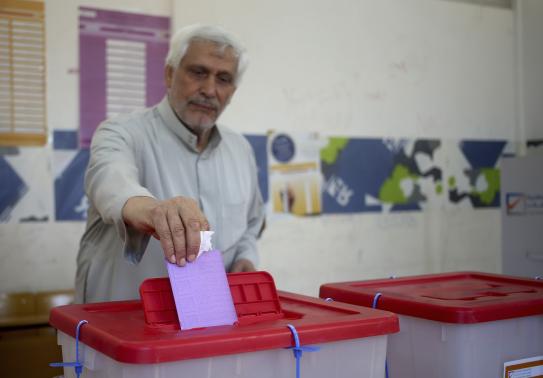
A woman votes at a polling station inside a school in Tripoli. A woman votes at a polling station inside a school in Tripoli.


Barely 13 percent of Libyan voters went to the polls by noon on Wednesday to elect a new parliament that officials hope will help restore order three years after the fall of Muammar Gaddafi.


Fresh fighting in the eastern city of Benghazi, part of the growing turmoil in the oil-producing country, overshadowed the vote. Residents reported explosions and a military plane firing in an area where forces of a renegade general and Islamist militants clash regularly.


Turnout was widely expected to be much lower than in July 2012, the first free national vote in more than 40 years. Some 1.5 million voters registered, roughly half the 2.8 million on the rolls in 2012, after registration rules were tightened.


By noon, only 200,000 had cast their vote, election officials said, blaming hot weather.


Libya is still struggling to make its transition into a stable democracy after four decades of one-man rule. The country has slid deeper into chaos since the renegade army general Khalifa Haftar opened a campaign against Islamists in the east.


Live cameras from Libyan news channels showed mostly empty polling stations. Officials planned to release more turnout figures in the evening and full results are not expected until later this week.


Some polling stations stayed shut for security reasons in the eastern Islamist hotspot of Derna, Kufra in the southeast where tribes regularly clash, and the main southern city of Sabha, officials said.


A man casts his vote at a polling station during a parliamentary election in Benghazi. A man casts his vote at a polling station during a parliamentary election in Benghazi.


LIBYA STRUGGLES


Without a functioning government and parliament, Libya is struggling to impose authority over heavily-armed former rebels, militias and tribes that helped oust Gaddafi but who now defy state authority and carve out their own fiefdoms. Libya also has a budget crisis. Protests at oilfields and shipping ports by armed militias have reduced oil production, the country’s lifeline, to a trickle.


Tripoli’s partners in the West hope the vote will help it to begin rebuilding a viable state. Its nascent army, still in training, is no match for fighters hardened during the eight-month uprising against Gaddafi. Many Libyans fear the vote will produce just another interim assembly. A special body to draft a new national constitution has still not finished its work, leaving questions over what kind of political system Libya will eventually adopt.


To discourage political infighting between parties, which paralysed decision-making and led to a crisis over two rival prime ministers in May, candidates must run as independents rather than as party representatives.


“I am participating again to vote for the House of Representatives so we can rebuild Libya,” said Munira Ashour, a female teacher. “I didn’t vote for any congressional members who had nominated themselves again because they have had their chances without making any progress.”


In Tripoli, former Prime Minister Ali Zeidan made a surprise appearance to cast his vote after returning from Europe, where he had fled when parliament ousted him in March.


“We hope the elections will achieve their goals and that the House of Representatives will make a new start, better than the past,” he told Reuters.


BENGHAZI FIGHTING


In Benghazi, polling stations opened despite clashes breaking out in one district where Haftar and Islamists often clash. Details were not immediately available.


Divisions need to be bridged between Libya’s west, once favoured by Gaddafi, and the neglected east where many demand autonomy and a greater share of the nation’s oil wealth.


The vast desert country has several power centres. The Islamist Muslim Brotherhood, rooted in rural western coastal cities, is vying with tribal areas in both the west and east for control of the oil producer.


Electoral authorities tightened registration rules by requiring voters to show a national identification number, which many Libyans lack given the collapse of state services.


The new parliament will again be made up of 200 seats, but will be called the House of Representatives. Thirty-two seats are allocated to women.


Around 1,600 candidates were on the ballot, about 1,000 fewer than in the previous parliamentary vote. Some candidates put up street posters or platforms on social media, but the announcement of the election a month ago left little time before voting began, and there has been no real campaigning.


Invalid item ID specified
Libyans slow to vote for new parliament in test for transition

Iran hopes for end of sanctions boom but investors still wary


An Iranian flag flutters in front of the United Nations headquarters in Vienna. An Iranian flag flutters in front of the United Nations headquarters in Vienna.


With the prospect of a diplomatic breakthrough next month bringing an end to Iran’s international isolation, officials in Tehran are preparing to roll out the red carpet to foreign firms. But a tough legal environment and tricky domestic market mean the hoped-for billions in investment may not come soon.


Only a few more weeks remain before the July 20 deadline to conclude talks between Iran and Western powers aimed at ending sanctions in return for limits on Tehran’s nuclear program.


Hopeful of a breakthrough, Iranian officials are putting together a package of incentives to lure foreign investors into sectors ranging from oil and gas to agriculture, light manufacturing and free trade zones.


The incentives, which could be unveiled quickly after a diplomatic deal, are expected to include tax breaks, steps to ease the burden of bureaucracy on foreign firms, and possibly assistance in obtaining resources such as land, say businessmen and lawyers. Iranian officials have talked of the possibility of new types of production-sharing contracts to lure oil investors.


But as the deadline approaches, some foreign firms’ initial euphoria over the prospect of investing in Iran is giving way to a harder-headed assessment of the obstacles and the risks.


Even if a nuclear deal is reached, unraveling the web of sanctions is likely to be a long, complex process, possibly taking years. Companies will then have to deal with an uncertain legal framework and chaotic business environment within Iran.


Hamid Mojtahedi, group legal counsel at Links, a Dubai-based consultancy that helps foreign firms set up in the region, cited the case of a German automaker which earlier this year explored the possibility of establishing a sales venture in Iran.


The idea was to get a jump on its competitors by having a skeleton operation already in place when the sanctions were eventually lifted, Mojtahedi said, declining to name the company because of commercial sensitivities.


The firm ultimately calculated the potential profits didn’t justify the risks, deciding not to go ahead until the sanctions outlook and Iran’s own regulatory framework were clearer.


“There are two main considerations for companies planning to establish themselves in Iran: the sanctions regime and the domestic business environment,” Mojtahedi said. “The latter is in some ways more of an obstacle. So most companies are moving cautiously.”


SANCTIONS


Nobody doubts the potential of Iran, with a population of about 76 million, to become a big investment draw. It is attractive partly because it has a far more diverse economy than its neighbors; major industries include not only energy but autos, farming for export, electrical goods and even medicines.


Consultancies around the world are offering seminars on Iran to interested foreign executives. Last week, France’s Renault said it was looking for a financial partner to resume making vehicles with local partners in Iran, from which it withdrew after sanctions were tightened in 2011.


But this interest may not translate into any quick flood of money into the country. For one thing, the nuclear talks may not succeed; the latest round of talks ended in Vienna last week with Iran denouncing “excessive demands” on it.


At an Iran investment seminar attended by scores of executives and lawyers in Dubai last month, some said the best scenario they could realistically hope for would be an extension of the talks into next year.


Even if a nuclear deal is reached, the sanctions won’t disappear quickly. Over decades of confrontation between Iran and the West, they have developed into a complex network of overlapping measures introduced by the U.S. government, the European Union and the United Nations, covering areas from banking and shipping to autos and aviation, as well as individual Iranian firms.


Untangling the rules will take considerable time – and in the meantime many foreign companies, alarmed by fines worth hundreds of millions of dollars imposed by the U.S. government on violators of its sanctions, may avoid taking legal risks.


“It will be a long and gradual process. The idea that the sanctions will disappear overnight is not correct,” said Suzanne Maloney, senior fellow at Washington’s Saban Center for Middle East Policy and a former U.S. State Department policy advisor.


She said the cases of Iraq after the 2003 U.S. invasion and Libya after the fall of Muammar Gaddafi in 2011 suggested it would take many months or even years for the Iranian sanctions to be dismantled completely.


The single most damaging U.S. sanctions measure against Iran was imposed in November 2011, when the U.S. Treasury used Section 311 of the USA PATRIOT Act to identify Iran as an area of “primary money laundering concern”.


This effectively froze Iran out of the international banking system, making much investment there almost impossible, by forcing banks around the world to choose between dealing with Iranian institutions and doing business with U.S. ones.


In theory this measure could be lifted soon after a nuclear deal if the Treasury changed its designation. But the original designation was based not only on Iran’s nuclear program but also on allegations of support for terrorism; Washington might find it politically difficult to row back on that charge.


Iran’s oil industry would be one of the most attractive areas for foreign investors, but for that reason, the sanctions web around it is particularly dense. Related sanctions have been imposed on shipping lines and ports. So a nuclear deal might not mean any quick boost to the industry.


An executive at a top European consumer electronics firm, in Dubai to explore the possibility of doing business in Iran, said Western companies would have to worry about the “reputational risk” of investing there even after sanctions were lifted, as they could face pressure from their shareholders and the public.


GOVERNMENT


Attracting foreign investment is a priority for the administration of Iranian President Hassan Rouhani, who won a landslide election victory last year partly by promising to repair the sanctions-ravaged economy.


Iran’s stock of foreign direct investment was just $37 billion in 2012, according to the latest data from the United Nations Conference on Trade and Development, against $76 billion for Nigeria and $199 billion for Saudi Arabia.


The data suggests Chinese firms have been using the absence of Western competitors in the past few years to increase their presence in Iran, but even they have moved slowly: the stock of Chinese investment reached $2.1 billion, according to UNCTAD.


Despite the measures expected in the incentives package, Iran is still a tricky environment in which to do business.


Labor laws, for example, make it very hard to lay off staff, the legacy of Iran’s 1979 revolution. For now, Rouhani may lack the political capital to reform these laws.


“Institutional changes need to happen, in laws and regulation, for the country to become an investment destination for a wide range of foreign companies,” said Mojtahedi. “The economy has been closed for 30 years and has to revamp itself.”


Iranian-born economist Mehrdad Emadi of the Betamatrix consultancy in London said foreign investors would face opposition from entrenched, politically powerful interests in Iran which have profited from preferential access to state contracts and hard currency supplies during the sanctions years.


“The bigger foreign companies may be able to cope with this, but for the medium-sized ones it may prove difficult.”


The European consumer electronics executive said that even after sanctions were lifted, she expected Iranian officials to restrict foreign companies in order to protect what they see as the interests of the national economy. Repatriating profits could also be hard.


And even if foreign firms get the wholehearted support of the government, they may find it challenging to operate in a business environment long isolated from global trends.


Selmar Welloso, manager for the Middle East and North Africa at Magnesita, a Brazilian maker of materials for steel, cement and glass manufacturers, said his firm might eventually establish operations in Iran if sanctions were lifted. But he said he had been struck by the obstacles on his visits there.


“In some ways their way of doing business is like the early 1980s. There were two or three secretaries to every manager. People running $1 billion companies didn’t use personal computers.”


Welloso said it was not yet clear how welcoming Iran would be to foreign investors: “Iran needs to decide – do they want to be a Turkey or a Venezuela? At the moment it’s not clear which one it will be.”


Invalid item ID specified
Iran hopes for end of sanctions boom but investors still wary

Iraq's PM says committed to forming a new government


Iraqi Prime Minister Nuri al-Maliki said on Wednesday he is committed to forming a new government on time as he fights growing calls from his opponents, and some of his former allies, to step aside.


A mounting Sunni insurgency is threatening to rupture Iraq 2-1/2 years after the withdrawal of U.S. troops, and Maliki’s domestic opponents say he has made matters worse by alienating moderate Sunnis who once fought al Qaeda but are now teaming up with the extremist Islamic State in Iraq and the Levant (ISIL).


“We will attend the first session of parliament in harmony with the constitutional merits and out of the commitment to the call of the Supreme Marjaiya (Iraq’s Shi’ite clergy) and out of loyalty to our people,” Maliki said on state television.


On Friday, the Marjaiya’s Grand Ayatollah Ali al-Sistani himself called for the government formation process to begin.


Last Wednesday, the results of an April national election were certified, triggering a process that means the first parliament session must be held by July 1.


U.S. Secretary of State John Kerry said that in a meeting with Maliki on Monday the premier had “on multiple occasions affirmed his commitment to July 1″ as the date to start forming a new government.


While U.S. officials have been careful not to say publicly they want Maliki to step aside, Iraqi officials say such a message was intimated behind the scenes.


Invalid item ID specified
Iraq's PM says committed to forming a new government

EU regulators to decide on Apple, Beats deal by July 30


A pedestrian walks past a Beats brand display in the subway system of New York A pedestrian walks past a Beats brand display in the subway system of New York


European Union antitrust regulators will decide by July 30 whether to clear Apple Inc’s $3 billion bid for music streaming and audio equipment company Beats, the European Commission said on Wednesday.


IPhone maker Apple unveiled the deal last month, which will help it catch up in the fast-growing and lucrative music streaming business.


The Commission can either clear the deal unconditionally or demand concessions if it sees competition issues. It can also open an extensive investigation if it has deeper concerns.


Invalid item ID specified
EU regulators to decide on Apple, Beats deal by July 30